

Worldbuilding Issue [6]: The Theme Behind the Pages
The creative mess and magic that led to our most expansive issue yet.

Hello! It’s been some time. I am excited to share that we have sent Issue [6] of TAX Magazine to print. It’s our largest issue yet, coming in at 370 pages. We’re also bringing back multiple cover options, offering 6 stunning (and very different) covers, although we won’t reveal those quite yet…
Printing and shipping the magazines takes quite some time, so the issues will be out in December (subscribe to reserve your copy!). In the meantime, I want to share a bit more of the behind-the-scenes of how we made this issue. Starting today with revealing the theme.
TAX is a daringly intimate gay magazine that collects raw NARRATIONS and heart-pounding IMAGES to expose a world that is BRASH, CURATORIAL, and IRRESISTIBLY FUN.
Designed in Paris, published in Los Angeles, printed in Ghent, distributed in London, and available worldwide.
View more at taxmagazine.com.
Headed South?
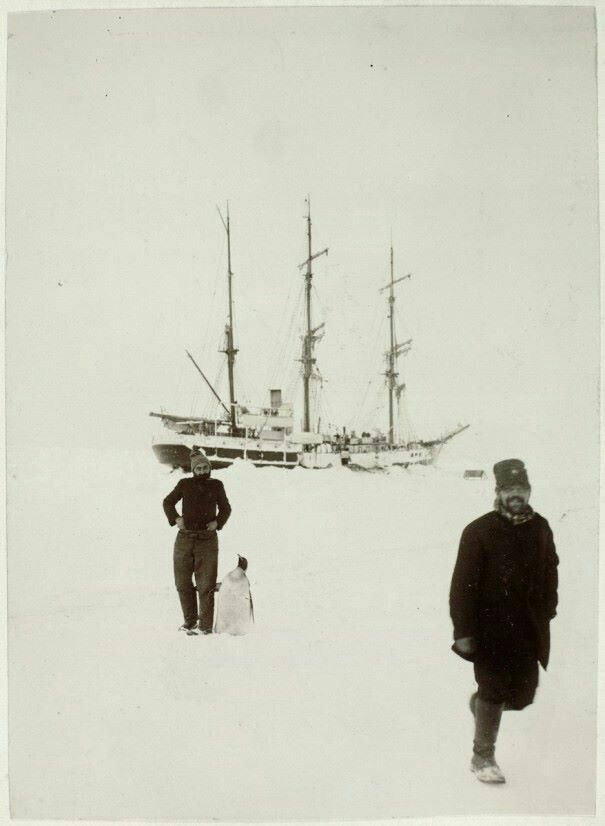
The original inspiration for this issue came from this concept of ‘heading south’. Specifically, I was interested in producing stories in the southern hemisphere, as that felt different than the typical New York-LA-Paris content we tend to do. I wanted something adventurous and to broaden the TAX world a little bit. Essentially, Issue [5], “Continuum” dealt with time, and this time around we wanted to play with space.

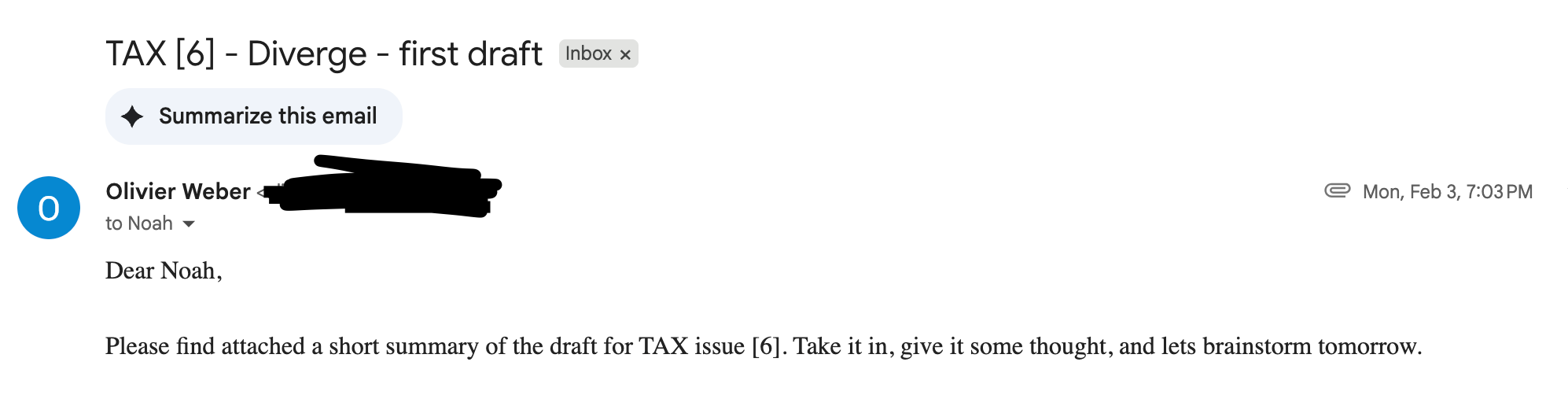
Olivier and I sat down in January to begin discussing my idea. This is one of my favorite parts of building the magazine. They are really fun what-if-we-did conversations, and it’s also a very collaborative process where our team gets to bring different ideas to the table, build on one another’s concepts, and think about worldbuilding for the entire issue.
While I came with my original ‘headed south’ idea, Olivier (our creative director) worked some magic, and took my little inkling of an idea, and turned it into a broader, more encompassing concept that asked questions and provided more breadth of jumping off points. He wanted to take my idea of geographies and ‘far-flung’ (a word we kept returning to), and turn it into an exploration of shifting patterns, and what it means to break away. Thus, Issue [6], Diverge was born.
Let’s get ~conceptual~
The funny thing about the themes is they tend to be quite abstract. Sometimes I think it would be a lot easier if we just did an issue theme like “blue” or “spring” or something like that. But that can get very restrictive, and we want to give contributors lots of room for interpretation. So we generally align on the broader theme or title (e.g. “Diverge”, “Continuum”), and draft a little paragraph story.
For [6], we ended up with this:
By default, we follow the pull of the compass— heads turned North, eyes fixed on the path prescribed. From its origin, it has dictated direction, a tool for survival, a guide toward the light. Literally and figuratively, the single needle charts our course.
But what happens when the field shifts? When unseen forces bend the pull, distorting the path we thought immutable? To deviate is not to be lost but to witness something others never will. [6] plays with the invisible tension between directions, pulling stories from all corners of the world—North, East, South, and West—until the axis itself is questioned.
The compass promises truth. But what if truth is a moving target?
Turning a concept into a spread
Once we’ve aligned the theme, but before starting any production for the issue, we typically build out an outline with the different stories we want to have, the mix of editorial vs. interview vs. longform stories, etc., and then the page counts for each spread.
This helps us gauge how the entire issue will come together, and also helps us plan for less sexy details like page count allocation across different types of paper, budget allocation, etc.. We also place stories into the different chapters to try and build a full narrative as one goes through the stories.
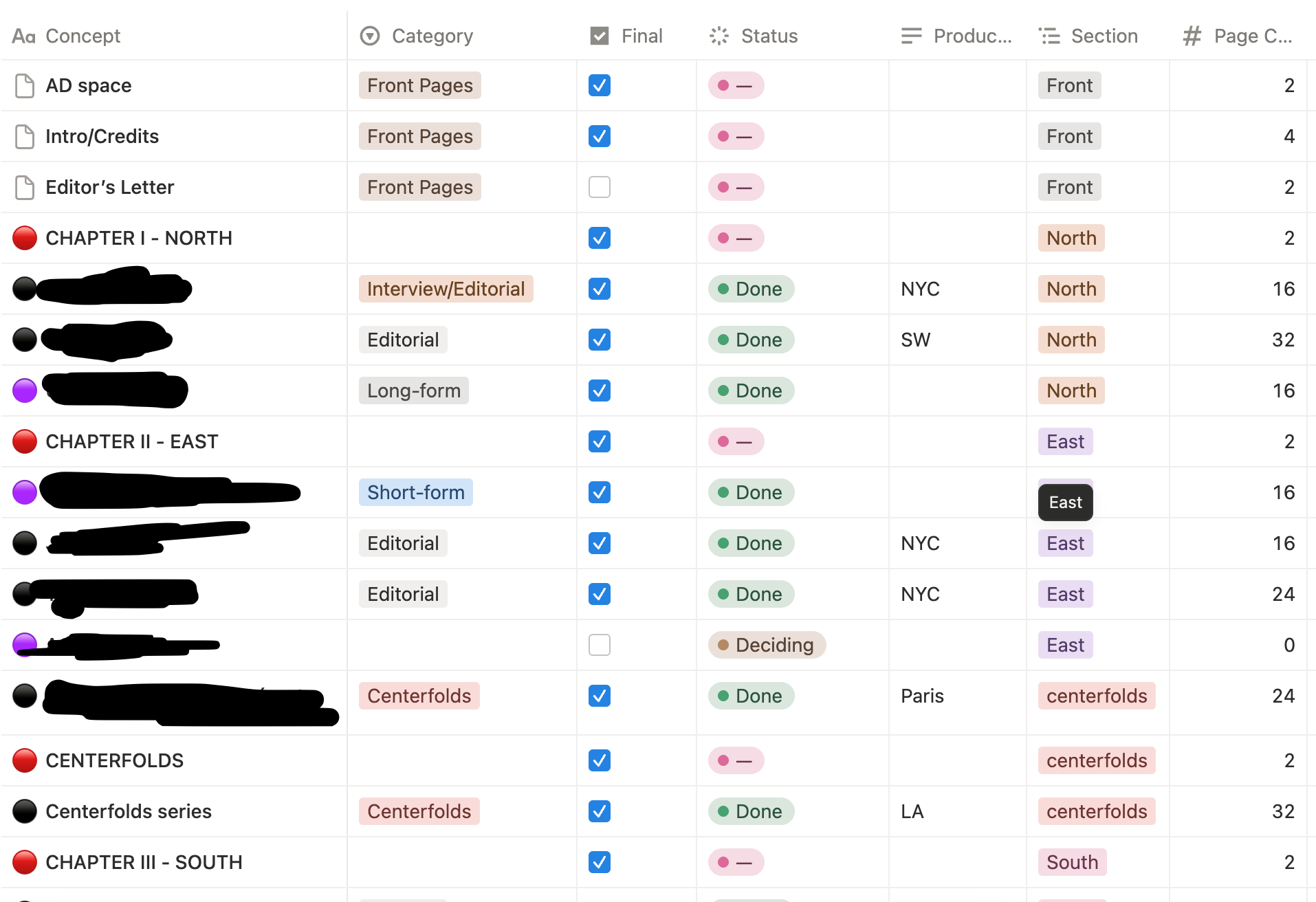
Often we will start with a few key stories that we really want to incorporate, such as a major editorial, an interview with a talent we’ve secured, or a specific person that we want to work with. Those ‘hero’ stories or features become the skeleton of the issue outline, and then we will commission work or look for submissions that help round things out and build a full, cohesive issue.
Moodboarding out our visuals
This time around, we went a step further than the theme document and outline, and created a full issue concept deck before beginning production. This process was similar to the moodboarding we will do before a specific shoot, but was more general across the entire issue.
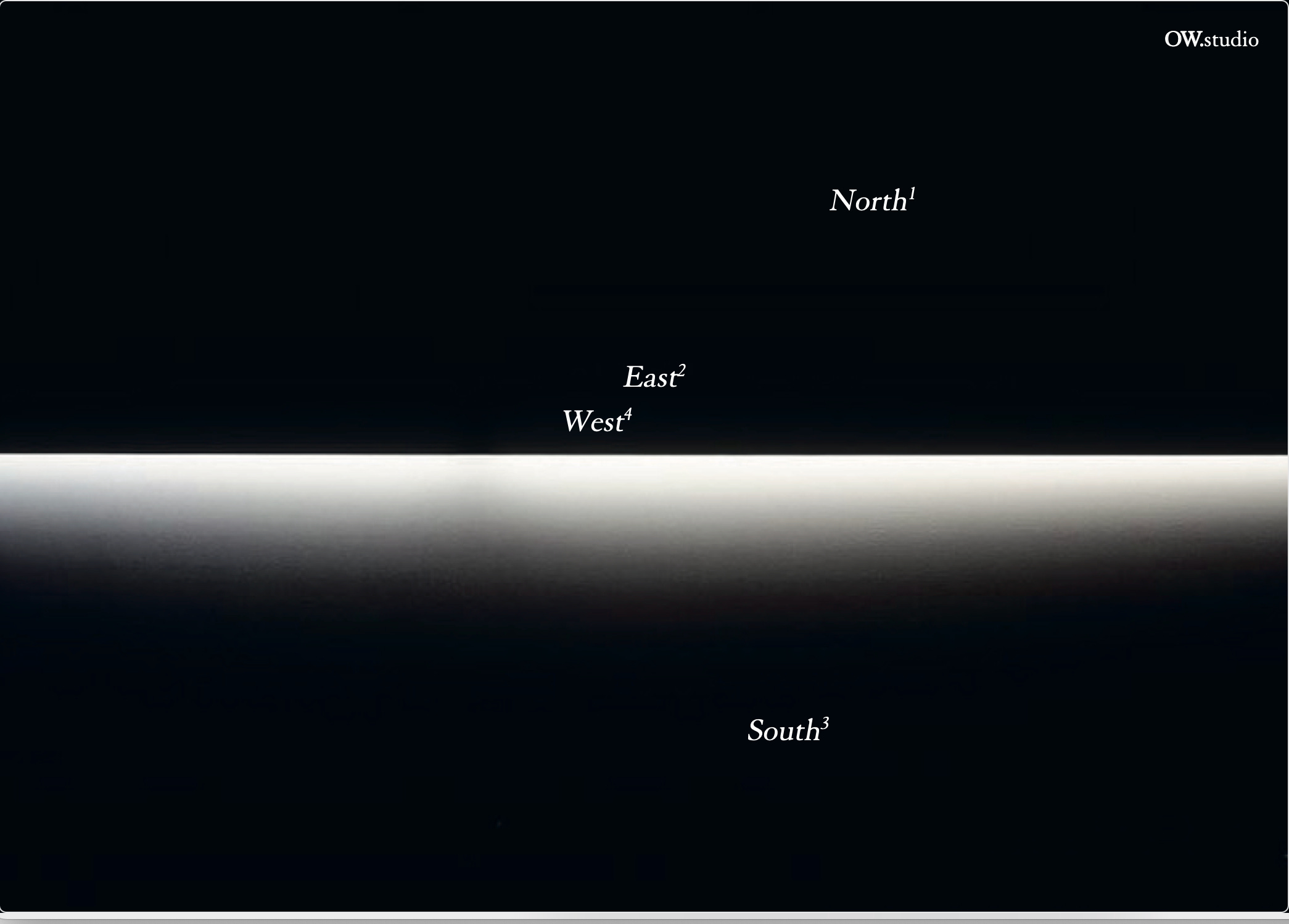
We hadn’t done this step before, but one thing I wanted to improve on from Issue [5] was having more color and more variety of visuals. I loved our last issue but it had a lot of neutral tones and I wanted more vivid colors this time around. So we made this deck to help articulate the visuals and color story for the different chapters of Issue [6]. I think this was a useful exercise/forcing function for us to align internally on what we wanted issue [6] to look like, and it also became a great resource to share with contributors/photographers/etc. to articulate our vision and get them excited.


Tying it all together
Armed with our theme overview, our visual overview deck, and an outline with a few key pieces, we set to work. As to be expected, many things often shift and change. Pieces become larger than their original intended page count, because we really love how the images turned out. A talent falls through. Someone amazing responds to a DM, and says they’ll do a story with us. We receive an amazing submission that we just have to include. The final print file always ends up surprising me, but in the best way. Part of the fun with any creative endeavor is watching it take on a life of its own.
All that said, I think we did a really great job of exploring the theme with this issue, and I’m really proud of what we’ve created. I hope the final product takes our readers through a delectable, raccous, and fun journey through four chapters - North, East, South, and West.
Our team takes a lot of pride in the effort and intention we put into developing and exploring a cohesive concept. I never want TAX to just be hot shirtless guys (although we do have that too), but I want it to be a real, meaty body of work that people can dive into, wrestle with, and find both questions and answers about the gay experience. And of course, pure fun too. That’s an ambitious goal, but I think we’ve gotten closer to achieving it with each subsequent issue.
How to get your copy
If you’re in the US and you’d like to secure your copy, you can become an annual print subscriber and we’ll ship a copy directly to your door. Our last issue sold out in just a few days, so this is the best way to guarantee your copy and save on shipping costs. We’ve also introduced a system where subscribers can now pre-select their cover story.
We will also offer some individual copies for sale on the website, and we’ll be back in even more stores this time around, from Seattle to Paris to Tokyo.
I can’t wait for you all to see it. Thank you so much to everyone who made it possible. See you soon.
Noah
Noah!! Reading the process from ideation to planning out the spread, and actually making it happen is so impressive and inspiring. Thanks for sharing such a cool insight on your thoughts for this new issue. Looks like another success. 🙂🙂🙂
Some wonderful and valuable insights on your process. Thank you for sharing!